Here I Stand

Here I Stand
Showing posts with label business. Show all posts

Monday, November 19, 2012

Bad Business Decision of the Day: Carl's Jr. CSU-Long Beach Student Union

Bad Business Decision of the day: Carl’s Jr. CSU-LB Student Union
After work and before class the other day I went to Carl’s Jr. At school to grab a bite to eat. I ordered my food and asked for a small coke. The guy informs me that they are out of small cups, and they can only sell me a medium. Well, if they are out of small cups, through no fault of my own, should they not offer me a free upgrade? This seems logical, as it is clearly the responsibility of the establishment to provide what the customer wants, right? Apparently, this is incorrect. I was informed that the cashier cannot do that, as then they would be “losing money” on the deal, because clearly, the $.30 difference between the cost of a medium and the cost of a small eats too much into their profit margin. This makes sense… until you take into account that the profit margin on soft drinks is already ridiculously high, and one of the largest money makers for the fast food industry, and restaurants in general. There is typically a 5-600% markup on even a small coke.  This is the reason many fast food joints put in self service soft drink fountains – it streamlines the business process enough that they are still turning hire profits by allowing their staff to concentrate on speed of service and food processing (which has a dismal margin of around 6-8%) keeping in mind the free refills that this offers, it still does not erode profits enough for it to be regulated or controlled at the local level.
The free refills are of note, as I would have received roughly the same amount of coke no matter what size I purchased or was issued. The question then becomes, am I willing to pay the marginal cost between the small and the medium, for a product that is already marked up and I am loathed to pay restaurant pricing for in the first place? The answer is no, no I am not. I take a water and leave. The cashier, and likely the manager as well, who instructed him to try and sell people medium drinks instead of the smalls they requested are being penny wise and pound foolish – they missed out on a sale of $1.69 in order to push a sale of $1.99. They are left with only the sale of the very low margin food, without the extremely high margin soft drink to augment it. Moreover, with the marginal rate difference between what I wanted and what they tried to sell me, and the loss of the sale, it will take six more sales of an inflated medium soft drink (meaning people who wanted a small, but are willing to pay extra for the medium… not people who are buying a medium anyway) in order to make up for my one lost sale. They completely missed the big picture on this, and in the extremely low margin world of fast food, losing sales can quickly be compounded.
Customer loyalty is one of the most important features in the restaurant industry – it is far cheaper to keep a customer than to create a new one. I am not saying that I will never eat at a Carl’s Jr. again, but I was a bit disappointed in the lack of customer care. I will admit that the amount of ownership, however misguided, exhibited by the employee was impressive, but when you set up shop on the campus of a highly rated business school, be prepared for critiques of your business.

Tuesday, August 28, 2012

Why Hiring a Veteran Could Be The Best Thing You do for Your Business.

 
According to the latest numbers by the Iraq and Afghanistan Veterans of America (IAVA) and Businessweek, there are nearly half a million unemployed veterans in the United States. The unemployment rate for this highly respected and qualified subset of America far exceeds that of their same age, race, and educational demographics that have not served, and this is truly a crime. The unemployment rate for veterans age 18-24 is over 30% as compared to 15.3% for non-vets in the same age group. What is worse is that the trend keeps going. More and more veterans are becoming unemployed, all while more and more non-vets are getting jobs. This is a huge pool of untapped talent that many employers simply have never even considered for their open positions. True enough, it can be daunting for an interviewer to look down at a resume laced with bullets points about, well, bullets. I mean what does leading a fire-team in combat, being honor graduate from a long range reconnaissance course, or writing training plans for an infantry battalion have to do with honest work in respectable society? Quite a bit, I assure you. In fact, hiring a veteran could be the best thing that you could do for your business.
                Lets overlook the obvious advantages – the $2500 tax credits that can be applied to your company’s returns for hiring a soldier, the federal programs covering a percentage of your newly employed veteran’s salary, the vocational training programs to ensure your new employee is well versed in the most up to date business practices, or the myriad of state and local programs designed to aid and reward businesses that employ veterans. Any CFO or Human Resources director worth their weight would already know this, and right or wrong, let us assume that they do. Lets also overlook the moral obligation that we, as a society, may, and ought to feel toward those among us who raised their right hand and pledged to give their life, if necessary, supporting our nation during a decade of war. These men and women come home from enduring unimaginable hardships and are often ostracized, labeled, mistrusted, and cast out by the very society they have been fighting for. We can overlook this obligation because of course our readers would have the moral fortitude to do the right thing, take a chance, and offer more to our returning veterans than a half hearted “thank you for your service” that drips more of disdain and pity rather than admiration and respect. All of this should go without saying, and to be honest, employing a veteran is its own reward. This article, however, is about the skills and experience that those who have served can offer to the modern business world.
                I have said in the past the translating military skills and experience into civilian jobs requires a bit of creative interpretation, but this does not mean that one has to use their imagination or make things up. What are some of the most basic qualities and characteristics that employers say they want in the people they hire? Show up on time, work well in a team, take responsibility for their actions, get results, actually do their job… oddly enough, there is a large portion of the employed population for which these simple characteristics are completely foreign.  I am not going to deign to make assumptions about the current crop of entry level employees, but what I have observed in the business world from the entitlement generation is not promising. 
                Don’t get me wrong – I have been fortunate enough to work for two Fortune 500 companies, including my current position, and the level of dedication and competence by the vast majority of their staff is exceptional. Veterans cannot fool ourselves into thinking that our military service gives us a monopoly on hard work and drive in today’s society, because that simply is not the case. There can be no resting on one’s laurels, and military experience is no substitute for knowledge base and required skills or prerequisites.
                But at the same time, much of what we offer is intangible. They are necessary additions to the successful function of any business, and while often overlooked as a given, they are most certainly not. There are many similar essays out there on the leadership qualities of veterans, and how they can help push a business to the next level. There are even more on veterans’ stellar performance under pressure, and how the rigors of combat shape them into steady, confident citizens. All of this is well known. What is not often discussed, though, is their resourcefulness, their drive and determination, and the fact that for most of us out there, failure is simply not an option.
                A veteran will do what it takes to get the job done. If they aren’t familiar with a computer program, they will learn it. If they’ve never driven a particular fork lift, they will figure it out. If a deadline is looming and everyone at the office is too tired, a veteran is the kind of person who will put on the coffee, pound and energy drink (possibly a Rip It), and get the job done, whether they are particularly vested in that project or not. In the military, we train to standard, not to time, and there are two ways to do anything: The Right Way, and Again. This “Good enough for government work” stereotype comes from bureaucracies, not from the uniformed services. If we are wrong, people die.
Blind obedience is also a myth. There is this ridiculous concept that men and women in the military do what they are told, no matter what, and cannot function without orders. It is true that those who have worn the uniform see the world slightly differently than others, but we see challenges to be overcome, and problems to be solved. We are intelligent and resourceful, creative and confident. If there is an issue, we will deal with it, and not rely on a supervisor to tell us how.
                We show up on time. We work late if we have to. We don’t complain (because hey, it could ALWAYS be worse) We do our jobs, and we know the duties of our superiors, so if necessary, we can do their jobs too. We don’t get rattled, we don’t get stressed, and we set an example for those around us. As GEN George Patton famously said “I am a soldier, I fight where I am told, and I win where I fight” – the same is true today, both on and off the battlefield. Veterans are not used to failure, and more often than not, it is simply an unacceptable outcome.  There are many in the business world that are willing to “Take a loss and move on.”  Not us. There is a reason why those who wear the US Army’s Ranger Tab declare that they will “Fight on to the ranger objective, though I be the lone survivor” – Veterans don’t quit. This is not to say we cannot recognize a bad decision or situation. After all, the first rule of battle for hundreds of years has been to “never reinforce failure.” It means we consider a different approach, a different angle, or if our position IS untenable, we still find a way to complete our objective. Being tactically flexible is not something that is taught in business school.
                The learning curve for veterans is far shorter than with other demographics. Most of my evidence is anecdotal, and taken through experience, but there are dozens of surveys and statistics that show veterans as being better students in college and with a quicker grasp of foreign concepts – be it a foreign language, or a computer program. Veterans learn quickly, and they figure things out on their own. They do what they need to do to get the job done, and more often than not, they will surprise and employer.
                Far too often I have gone into interviews and been told “Thank you for your service, but you’re not what we’re looking for” with a resume that is far more business oriented than many I know. Some employers see military service as a liability rather than the mark of distinction that it truly is. They don’t see that a solid veteran in their position can lift up those around them, and bring the entire team to a higher level. 
                 If you’re a veteran, then you and I both know that your real resume is written on your face. It is in the set of your jaw, and the firmness of your handshake. It is in how you carry yourself, and how you treat those around you. I know that you can, and will, get the job done, but it will take more than that to get hired. It is up to you to put those skills on paper, and to convince someone of it who may have a very disillusioned view of the world you have come from. It is daunting, but it is not impossible. If you are an employer who cannot see beyond the stigmas and stereotypes of the uniform they used to wear, then in the long run, it is simply your loss, but right now, as our nation stands today, it affects us all. Besides, hiring a veteran might just be the best thing you can do for your business.

Friday, June 22, 2012

Oliver Wendell Holmes Mural

Found this mural while wandering around on my lunch break. It is on the back end of the Legacy Oceangate Towers and it caught my attention. I just thought it was pretty cool. Pictures were taken on my phone, so forgive the quality, but the Oliver Wendell Holmes quote was also quite appropriate - especially in the Business District of Long Beach.


Enjoy!


Published with Blogger-droid v2.0.4

Friday, May 18, 2012

Facebook IPO

Facebook IPO


So if you pay attention to financial news – or really the news at all – there has been one major theme that has dominated the headlines this last week: the Facebook IPO. The already fabulously wealthy founders of the wildly popular social media site are set to become multi-billionaires. And why shouldn't they? Mark Zuckerberg and crew have quite literally changed the world as we know it. Where Myspace and Friendster came before, Facebook has united what was once a fringe, hipster culture, into not only the mainstream, but into everyday life. I don't know anyone who doesn't check their Facebook page at least a few times a day. Most do it on their phone when they have 30 seconds of downtime. It has millions of users, and is probably the single most visited website on the internet. Think about it. Everyone has their own preference for news sites, movie sites, professional sites, etc. and this divides the audience. Facebook, however, is a global hegemon and not just in the social media field, but in the world.


And as of today, you can own a piece of this hegemon. Facebook is having it's Initial Public Offering (or IPO) as I write this, and you too can capitalize on the all encompassing powerhouse that is the social network. This question is, though, would you want to? There is no question as to the brilliance of Zuckerberg's creation, and getting in on the ground level would have been a life changing experience. But has the media giant run its course? They were asking $38 a share for their IPO, and last I checked, they were selling for right at $41. This is an excellent margin for their first day of trading, and Zuckerberg should rightly be excited about this successful IPO, but honestly, I am not sure where Facebook will go from here.


Facebook is not Apple – who has stunned the world with constant innovation and new invention, shaping society with their ever changing line of products. Their stock price went from somewhere in the $30's to over $300 in just a few years. Facebook, for all the changes that they make to their layout, does not produce... well, anything. Yes, they provide an audience to market to, and have done an excellent job tailoring their ads to what their readers want to see, but have you ever clicked on a link? Sure, I read shares, and go through articles, and get really involved in my social networking from time to time, but I don't think I have ever bought something because I saw an ad on Facebook. Company's are starting to realize this. Earlier this week GM pulled all of its ads, saying that it just wasn't seeing results. I see facebook as being an excellent tool for niche brands and specific products – using their trageting dynamic to tailor the market that sees their ads to exactly the people they want to sell to, but national brands and general products? Not so much. Everyone knows about the Chevy Cruze... and sure, maybe someone who has pictures of trees and birds on their page would like to hear about the eco properties that the car offers, but they might not base a $30,000 decision on an ad in a margin.


Do Zuckerberg and the team at facebook have the knowledge and skill to change this? To morph into a marketing scheme with Pintrest level devotion to products? Yes, they certainly do! Will they do it? I don't know. I anticipate Facebook having an excellent IPO, maybe topping out as high as $45, but hitting a plateau almost immediately afterward. There will be a lucky few – typically the high end mutual funds and market managers who are invited to such high profile bids – who will make a killing off of Facebook, and with a shift in their innovation (not, by any means, a given) I could see it being a decent long term investment (5-10 years) and probably beating inflation in terms of appreciation, but if you can't buy it now, I wouldn't buy it next week. It's not going anywhere for a while, and there are better opportunities out there.

Thursday, April 26, 2012

ICBSC


This past weekend was the intensive phase of the semester long International Collegiate Business Strategy Competition (ICBSC). For those that I have yet to regale with the details of this endeavor, the ICBSC is a collegiate competition at both the undergraduate and MBA level where teams of contestants create a fictional company and manage it through seven years of operations. These operations run the entire gamut of what can be expected of executive level management, from sales forecasts and production management to marketing and finance.


My company, representing Cal-State Long Beach, and manufacturing waterproof and shock proof MP3 players (For the active lifestyle that those of us in Southern California enjoy) was called “Long Beach Sound” (get it?) and I took over the reins as the CFO (Chief Financial Officer) My original goal as CFO was to finance the company through our operating income. This is a risky strategy, as it keeps us from having to pay interest, dividends, or diluting existing outstanding stock, but it also relies on current and existing cash flow in order to expand – which we did, very quickly, and very aggressively. Combine this with the company’s commitment to training and research & development, and we were cutting it close to the wire every quarter in terms of financing our operations.

Decisions were made every quarter (represented as usually once a week and gradually speeding up all the way to once every two hours during the intensive phase.) and I am proud to say that we were completely successful in being a self-sufficient company. We never had to issue bonds, or dilute our stock with a further issue, nor were we forced into emergency bank loans – known as the financial kiss of death in this competition. In fact, Long Beach Sound made a serious dent in our capital structure by buying back about 20% of our shares outstanding, and retiring much of our bond debt, therefore increasing shareholder value and overall stability, all while reinvesting in the company.


Without getting too far into the details of the competition – which may bore many readers (we joked that it was similar to the number crunching Olympics, that we were “Matheletes,” and I even referred to the competition as the Business world’s varsity dungeons & dragons team) I learned a great deal. One of the main lessons learned was that everything depends on everything else. To say business is a vicious cycle is far too cliché, but also very accurate. Finance depends on sales, which depends on production, which depends on forecasts, which depends on infrastructure, which depends on finance. Somewhere in that mix, throw in marketing, training, R&D, advertising, and oh yes, the competition. That is something else that you have to worry about. Much like the old military saying of “The plan never survives the first contact” a business plan depends largely on what your competitors do. Their price points, their capacity, their production, all have to be carefully monitored and kept in mind in order to optimize your own.


In the end, I think we performed well. Long Beach Sound placed 1st in Business Documents (Strategic Business Plan, Annual Report, 10K, etc.) and 3rd in Overall Performance. We also stood in a division that had some very stiff competition. We faced down, and ultimately outperformed such illustrious MBA programs as Purdue, and Northwestern’s Kellog School of Business. The program was a lot of work, and a good bit of fun. I am glad that I did it, and it will be a nice bullet point on my resume, but I am glad it is over. It truly was like having another job, in addition to the one I already have, my full time Grad School schedule, and my obligations to the California National Guard. If you are an MBA student or Business Undergrad then see if your school is putting together a team for next year. It will be well worth your time.


Wednesday, February 8, 2012

Can boredom make you successful?

Yesterday I read This Charles Scott Article from CNBC. The synopsis of it states that while boredom is an incredibly annoying feeling on a daily basis, it can, in fact be very useful. Our society is used to instant gratification, instant access to information, and immediate responses. I myself am guilty of using my cell phone to check emails, facebook, stock reports, and yes, even twitter, when I have down time - anything to fill the few minutes here and there of empty space.

Scott's article, however, derides this common activity as more counter productive than anything else. Being bored lets your mind wander. It lets it work. It helps you be creative, innovative. You think about things that you normally wouldn't have. You go off on tangents, you daydream, you have ideas. All of this in today's society is becoming more and more what would set someone apart. These days a bachelor's degree is what a High School diploma was a generation ago. You can't go anywhere without one. It is expected, and to do anything more worthwhile, a graduate degree is almost required. Creativity and innovation may not get you in the door, but it will get you noticed, and get you advanced.

I am on an incredibly busy schedule - I go from work, to graduate school, to the gym, and then to sleep, only to start it all over again. My weekends are usually tied up in events, or I am drilling with the California National Guard. Almost every hour is taken up by obligations to either others, or myself. I would enjoy a little boredom from time to time, and considering the creative nature of both my job, and my educational pursuits, it seems like I might need it.

What I am trying out is nothing new, or revolutionary, as many people try to be productive on their daily commutes, but what I am attempting is to simply be bored. I have turned off my car radio. The hum of the engine, and the feel of the road is all that distracts me during the 2+ hours I spend driving on days that I have class. I am not claiming any dramatic breakthroughs, and it is a far cry from studying or working while on a train or a bus, but it can be quite calming. I get lost in my thoughts. I consider what I am doing that day, and why. My mind wanders. I come up with new ways to do things, and new concepts. This is only my second day of driving with no distractions, but it has already pushed me to write this blog, and given me ideas for several others - not to mention the half finished, viscereal concepts and ideas that are still floating around up there waiting to be fleshed out.

Go out there and make yourself bored. Meditate. Go for a walk. Stare out the window. Enjoy it. Revel in it. You might be surprised just how productive you can be when you do absolutely nothing.

Monday, January 23, 2012

Cufflinks offer USB Storage & a Wi-Fi Hotspot

Pretty cool story I got from PSFK - a tech inovation and inspiration site that I follow. Neat idea, kinda a spy thing going for it - especially with the Wi-Fi hot spot, but the price tag seems a bit high for my tastes. They've got to look at their target market in this situation. The cuff links are great, but anyone who will pay $250 for a pair of links is probably going to already have a Wi-Fi hotspot when they travel for business, and 2 gigs of storage is just something that these days is becoming more and more unnesecary, with such a focus and expansion on cloud storage. From a concept perspective, I love it, but it is almost a novelty rather than a business tool. Do I want a pair? Of course I do! Am I going to drop that much to buy them? Highly doubtful. Way to think outside the box though.


Cufflinks Offer USB Storage & A Wi-Fi Hotspot

This cool new use of a fashion accessory from Brookstone aims to improve the lives of those in the business community by offering them the convenience of a Wi-Fi hotspot and 2GB of USB storage housed in a pair of cufflinks.
The polished silver oval cufflinks can be used to share data and internet access between multiple wireless devices. After downloading the accompanying software, the cufflinks can be used as a high-speed Wi-Fi hotspot by nearby smartphones, tablets, laptops and computers. They can also hold up to 2GB for files and pictures.
This luxury item is described as “perfect for business meetings, travel and techies everywhere.” One pair will set you back $249.99.


via PSFK: http://www.psfk.com/2012/01/wi-fi-cufflinks.html#ixzz1kJUgK1Vx

Tuesday, January 17, 2012

Sport Coats - a brief introduction:

After my post a few weeks ago on 3 button suits, and how they are dated, but can still be worn if you know how (to recap: make sure it fits you, and NEVER button the bottom button) a friend of mine asked me to enlighten him on the subject of Sport Coats.

Sport coats are the essential transitional garment in any man's wardrobe. Someone who thinks they may never have need of a traditional suit can quite often find themselves in want of a decent sport coat. A sport coat is probably the most versatile piece in one's closet. It can dress up jeans and sneakers, or dress down slacks and a tie. It can take it's wearer from a business meeting, to a bar, to a casual event, and back again, with nothing more than a slight adjustment to the undershirt.

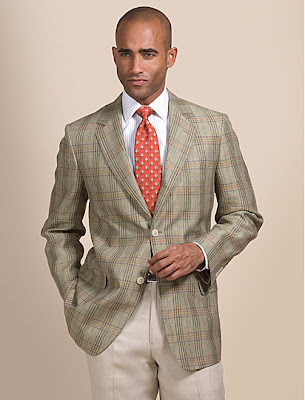
Sport coats traditionally have a few qualities that set them apart from a suit jacket – most noticeably, they typically do not come with a set of matching slacks. Sport coats are not just the traditional blue blazer that has been a mainstay of yacht clubs and alumni events for generations. They have evolved into a sleeker, transitional design that can bring together an outfit. Typically they have “shank” buttons – buttons that attach to the coat through a loop on their back rather than being sewn on through holes in the button, like on suit coats. Sometimes these can have crests or logos on them (for more personalization) and while traditionally done in bronze or gold colors, they are available in more subdued designs for the less garish among us. Another characteristic of a sport coat is a “Patch” pocket – or a pocket that is sewn onto the coat, rather than cut into it like found on suits. These can also be slanted to the outside, something the British call a “Hacking” pocket that is not typically found on a suit jacket. Another quintessential British characteristic to the coat would be leather reinforced elbows. These are less common these days, and I think lean far more to the casual side – really putting the “sport” into a sport coat. These are all just examples, and while any of these would immediately identify a jacket as a sport coat, none are required for it to be classified as such.

The ubiquitous Navy Blazer and a plaid sportcoat best worn with khakis or dark slacks

As far as how to wear a sport coat, that is entirely dependent upon both the wearer, and the occasion. Like a suit jacket, the bottom button, whether with a two or three button jacket, should always be opened, and while I very rarely open all the buttons on my suit, this is far more appropriate while wearing the more casual sport coat.

I personally think that sport coats are best when paired with slacks or khakis and decent shoes. Blue is a good go-to color, but there are many options to go through – just remember to keep your basic style rules in place. No mixing browns and blacks, shoes must match with belt and socks (you'd be surprised how often this is overlooked) etc. Depending on the weather, they can be worn with a vest or a sweater underneath, and typically a dress shirt. A tie is purely dependent on personal preference and the formality of the occasion.

An example of how a sport coat can be a very elegant business look. Take away the tie, add jeans and boat shoes, and you have a classy but still casual feel.

A sport coat with jeans can be great for casual Fridays, or any casual occasion where one just cannot bring themselves to wear a t-shirt or a hoodie – and again, these are more common than one might initially think. Street shoes or deck / boat shoes are an excellent choice with this look – especially if matched with the coat. If worn with a t-shirt of sweatshirt, make sure it is a solid color, or something unobtrusive. Your swagger should make the statement, not the logo.

On more formal occasions, even those without a tie, a pocket square can be an interesting addition. While in a suit I typically like clean, smooth lines, and keep mine squared off over the pocket, but in a sport coat, you can get away with far more interesting colors and styles. Try a peaked fold, or have the edges splayed out of the pocket. This works especially well with a bordered pocket square.

If you are still building your wardrobe, start off with something blue – it can go with everything, and can easily be built upon, but don't shirk the idea of a gray or tan coat. The more you use them the more you will find ways they are useful. Don't get caught up with one look or style. Experiment and play around with it, and it helps to keep your options open. Like I have always been told, “if all you have is a hammer, everything looks like a nail.” This old adage can be applied to everything from tools to tactics to fashion. Use what you have, but don't become too attached to your methods.

Sportcoat and hoodie? Don't be that guy. Seriously, you're better than that.


Saturday, September 24, 2011

Twitter...

So I have broken down and opened a Twitter account. Before you start with the deriding comments, twitter has changed the face of business the world over, and I am using my account to follow industry experts and financial trends - not post about what I ate for breakfast or gush over Justin Beiber.

Having an account has paid off in the first day - we were discussing HP in my MBA course last night, and because I follow @jimcramer I was the only one who knew Meg Whitmen was picked as thier new CEO - thanks to my twitter account, I rocked the in class discussion.
 
oh, and I am @jmsenk in case anyone is interested.