Here I Stand

Here I Stand
Showing posts with label Fashion. Show all posts

Friday, September 28, 2012

Know your Suit!

Know your suit! Peaked vs. Notched lapels
If you’re like most men, you pick your suit based on how it looks and how it fits. You know what you like, and you know what feels good, but that is about as far as many of us ever go. In truth, it is not necessary to know all of the how’s and they why’s and the what’s that go into the makeup of what you wear. After all, there are people who make a career out of worrying about this sort of thing so that you don’t have to. But remaining completely ignorant of what you put on your back is akin to knowing nothing about the car you drive. Unacceptable! Any self respecting man ought to be able to open his hood and explain the basics of how the internal combustion engine works. The same should be true for one’s attire.
I am not saying that a man should tailor his own cloths or know the ins and outs of bolts of cloth, but being able to tell a tailor what you want in how you dress will not only gain you a knowing smile and a nod, but also make the entire process of bespoke clothing far more enjoyable and simple.
Volumes could be written on the intricacies and nuances of a well cut suit. I will not bore you with such a tome. Instead, I’ll offer a few pieces of information to keep you informed, possibly adding on at various intervals to keep things interesting. We can begin with what is often the first thing noticed about a suit, yet rarely actually noted: The lapels.
There are two major types of lapels that one typically sees on a suit, the Notched lapel and the peaked lapel. Sartorial purists will note that I am omitting a shawl collar. Though a smooth, and clean look, the shawl collar is far more prevalent on tuxedos, and only very rarely on a suit or sport coat. As such, it is not germane to this discussion.
A lapel is notched when its line is broken by a deep V cut into the side. These are identical on each side, and usually around a third of the way down the lapel.
Notched Lapel
A peak, on the other hand, does not offer a smooth line, and contains a cut in the fabric where a barb or peak points upward from the lapel. These types of lapels were far more common back in the day than they are now, but they add an air of formality to a suit.

Peaked lapel
Upon inspection – because yes, I had to look – every suit in my closet has a notched lapel. This is the standard, go-to cut of a suit these days, and while you don’t have to go out of your way to find a peaked lapel, they are much less common. A peaked lapel is a throwback to the days of the wider collars, and can be seen adorning some double breasted suits. This could serve well to an add an old fashioned or classic flair to your attire. They are just as likely to be found on a tuxedo jacket as a shawl or notched collar, and the ridged lines of a peaked may be exactly what you’re looking for.
Wear what is right for you, but know what you wear, and why.
 

Friday, April 27, 2012

Fashionable Concealed Carry

Read this article on CNBC of all places. Fashionable concealed carry attire has been a long time coming, and I am glad to see it getting a bit of design attention. Woolrich is not exactly Armani, but for the moment, it will do. I am not altogether in agreement with the tone of the article, making it seem as if gun owners, and those with a Concealed Carry Permit (myself included) are on the fringe of society, or are the exception to the rule. This strikes me as typical New York Times reporting (where the article originally appeared) and from an area where being an armed or self-sufficient citizen often means enduring the disdain of polite society. Here in California, where Orange County has declared that I do not have a "Pressing Need" to carry a concealed pistol, despite being a Cali DOJ certified instructor (This state has a long and storied history of preventing its citizens from defending themselves, and I have a CCW from my home state of Florida) I have a tactical folding knife and a defensive flashlight as part of my EDC (Everyday Carry) and I find myself the go-to guy when a line needs to be cut or something needs to be illuminated. I carry this even in a tailored suit (give three-piece a chance!) in whatever polite company I find myself. I dream of the day when I can get a Brooks Brothers suit with a side vent for my FNP .40 or an Armani jacket cut wide across the back for a shoulder holster. Such illustrious publications as GQ and Esquire have made it well known their sartorial disdain of those of us who carry a weapon for a living, and I find this not only sad, but offensive to the very concept I spent my life defending: The Constitution of the United States. All I can say is that when the wolf attacks, he will find that not all among the flock are sheep. Are you?

The most frustrating comment of all though, appears to be the very last. The gun owner, who works in a gun store, declares that you should dress around your gun, not to fashion. I find this idea absurd.You ought to be able to do both. Neither side in this argument seems to be able to find a middle ground - and for the "everyday man" who wears work pants and a vest around town, you're not fooling anyone. You're carrying, and anyone who matters knows it. Whats worse, is that you look like a tool, and you orient your entire life around that .45 on your hip. I look good when I carry (when I find myself in a state that allows me to) and there is more than one way to print a gun. You can do it in your style, and demeanor - which does not always deter criminals, just everyone else in your life.

Original Link: http://www.cnbc.com/id/47158181/

New Fashion Wrinkle: Stylishly Hiding the Gun

By: Matt Richtel

Woolrich, a 182-year-old clothing company, describes its new chino pants as an elegant and sturdy fashion statement, with a clean profile and fabric that provides comfort and flexibility.
And they are great for hiding a handgun.

The company has added a second pocket behind the traditional front pocket for a weapon. Or, for those who prefer to pack their gun in a holster, it can be tucked inside the stretchable waistband. The back pockets are also designed to help hide accessories, like a knife and a flashlight.

The chinos, which cost $65, are not for commandos, but rather, the company says, for the fashion-aware gun owner. And Woolrich has competition. Several clothing companies are following suit, building businesses around the sharp rise in people with permits to carry concealed weapons.

Their ranks swelled to around seven million last year from five million in 2008, partly because of changes to state laws on concealed handguns.

Shawn Thompson, 35, who works at an auto dealership in eastern Kentucky, bought two shirts last month from the Woolrich Elite Concealed Carry line. Both, he wrote on his blog, are a step up from more rugged gear.

“Most of the clothes I used in the past to hide my sidearm looked pretty sloppy and had my girlfriend complaining about my looks,” he wrote, adding in an interview, “I’m not James Bond or nothing, but these look pretty nice.”

The shirt has a barely discernible side slit with Velcro through which, he said, he can yank his Colt 1911 from his waistband holster. Depending on circumstances and mood, he might also carry a folding knife and, at night, a flashlight in a pair of Woolrich chinos his girlfriend bought for him.

Carriers of concealed guns say the new options are a departure from the law enforcement and military look, known as “tactical,” long favored by gun owners.

The latest styles, by contrast, are called “concealed carry” or “covert fashion.”

“What we’ve tried to do is create a collection of garments that allows the end user to have stylish lifestyle apparel but have features in the garment that enable them to carry a weapon and draw the weapon quickly,” said David Hagler, a vice president at 5.11 Tactical, who was lured from Nike to work at 5.11, one of the biggest makers of clothing for soldiers and police officers.

The company’s growing concealed-carry line includes a lightweight water-resistant vest coming this fall — the sort of vest that is standard and trendy at any mainstream outdoor shop but has strategic pockets for guns. It also includes a stealth compartment in front so the wearer can appear to be warming his hands while actually gripping a pistol in a waistband holster.

Other companies are rushing to meet the demand for concealed-carry clothing. Under Armour, best known for its sports and action gear, will be adding a jacket and a plaid shirt with Velcro pockets for easy gun access.

Kevin Eskridge, senior director for outdoor product and design at the company, said the company had seen demand double in the last year for such clothing from traditional outdoor and sporting goods stores, like Dick’s Sporting Goods [DKS 50.65 0.57 (+1.14%) ] and Cabela’s. [CAB 38.69 -2.11 (-5.17%) ]

Mr. Eskridge said the Under Armour [UA 97.59 0.93 (+0.96%) ] apparel was catching on because of fashion but also because of its features, including moisture-wicking fabric.

“Others are making shirts with gun access but using regular cotton,” he said. With his company’s fabrics, “there’s no stink factor,” he said. And if gun owners do not use fabrics that wick away moisture, “You’ll literally rust out,” he added.

Gun experts suggest that there are many reasons for the growth in the number of people with concealed-carry permits. They say it is partly due to a changing political and economic climate — gun owners are professing to want a feeling of control — and state laws certainly have made a difference.
After a campaign by gun rights advocates, 37 states now have “shall issue” statutes that require them to provide concealed-carry permits if an applicant meets legal requirements, like not being a felon. (A handful of other states allow the concealed carrying of handguns without a permit). By contrast, in 1984 only 8 states had such statutes, and 15 did not allow handgun carrying at all, said John Lott, a researcher of gun culture who has held teaching or research posts at a number of universities, including the University of Chicago.
Only one state, Illinois, now forbids handgun carrying in any form, but the legislature is considering a change.
A majority of states have long allowed the open carrying of handguns, said Mr. Lott, who also provided the data on gun permits. But the reality, said Mr. Lott and other gun experts, is that people do not want to show others that they are carrying a weapon or invite sharp questioning from the police.
The clothing lines address a perceived need in the concealed-carry subculture. Gun owners say they want to practice “maximum uncertainty,” meaning that if a gun is sufficiently concealed, a potential criminal will be unsure whether to attack. Gun experts say the research is inconclusive about whether such tactics reduce crime. Regardless, the clothing makers are jumping on the line of thinking.
“When someone walks down the street in a button-down and khakis, the bad guy gets a glimmer of fear, wondering: are they packing or not?” said Allen Forkner, a spokesman for Woolrich, which started its concealed-carry line in 2010 with three shirts.
The company has since added new patterns for shirts, pants and the Elite Discreet Carry Twill jacket, in dark shale gray and dark wheat tan. In addition to its gun-friendly pockets, the jacket has a channel cut through the back that the company says can be used to store plastic handcuffs.
Not everyone who carries a concealed gun is a fan of the new fashion. Howard Walter, 61, a salesman at Wade’s Eastside Guns in Bellevue, Wash., said he preferred to carry his Colt — and a couple of knives and two extra magazines — in a durable pair of work pants.
“They don’t shout ‘gun,’ they shout ‘average guy in the street,’ ” said Mr. Walter, who years ago worked in sales at Nordstrom. But really, he said, the most important thing in picking clothing is to choose something that works for the weapon. “They should dress for the gun,” he said he advised his customers. “Not for the fashion.”

Wednesday, April 25, 2012

The Siege of Savile Row

Read this article off of The Chap - I can say that this is finally a protest I can put my position firmly along side. Savile Row has long been the home of gentlemen's tailor shop, hawking only the finest of wares. An invasion of this haven of the Bespoke Gentleman is nothing short of an atrocity, and the doing so by none so drab, mundane, and terrible as Abercrombie & Fitch (or more accurately, "abercrombie" for their children's line) speaks to the true horror of the situation.

Bravo on your fight gentlemen. I tip my hat to you, and might I add that never was there assembled a more impeccably dressed group of protesters. Dirty hippies? I think not!

Give Three-Piece a Chance!

The Siege of Savile Row

2012
On the morning of St George’s Day, April 23rd, swathes of immaculately dressed chaps and chapettes gathered outside No. 3 Savile Row to demonstrate peacefully – but firmly – against Abercrombie & Fitch’s proposed plans to open a children’s store there.
The protest began in earnest at 10:15am, when chumrades in arms marched around the corner to Abercrombie’s flagship store on Burlington Gardens, stabbing the air defiantly with home-made banners declaring “Give Three-Piece a Chance”. On the very steps of enemy HQ, Mr B The Gentleman Rhymer led the troops in song, chanting “All we are saying is, give three-piece a chance” adapted from John Lennon’s original.
Once pitched outside A&F’s flagship store, demonstrators were greeted by hordes of press, both local and international, accumulated on the opposite pavement. Also in attendance was the Chief inspector of Savile Row Constabulary, who commented to one of the protestors: “In all honesty, this is the best dressed demonstration I have ever seen.” We hope the Chief Inspector will add his signature to our petition and help keep riff-raff off the Row.
After a final rousing chorus of Give Three-piece a Chance, the protesters dashed off to the French House for a much-needed mid-morning snifter, since the Martini hour had long since passed. By 9pm GMT on Monday night, news of the protest had ripped through the press, both in the UK and across the pond, with reports featured in The Times, The Guardian, The Independent, Fox News, The Metro, The Evening Standard, The Los Angeles Times, The Washington Post, Bloomberg Business Week and more. With all this media attention, we’re confident Westminster Council will veto A&F’s application to open a children’s store on Savile Row, and allow it to remain the heartland of British bespoke tailoring.

Monday, January 23, 2012

Cufflinks offer USB Storage & a Wi-Fi Hotspot

Pretty cool story I got from PSFK - a tech inovation and inspiration site that I follow. Neat idea, kinda a spy thing going for it - especially with the Wi-Fi hot spot, but the price tag seems a bit high for my tastes. They've got to look at their target market in this situation. The cuff links are great, but anyone who will pay $250 for a pair of links is probably going to already have a Wi-Fi hotspot when they travel for business, and 2 gigs of storage is just something that these days is becoming more and more unnesecary, with such a focus and expansion on cloud storage. From a concept perspective, I love it, but it is almost a novelty rather than a business tool. Do I want a pair? Of course I do! Am I going to drop that much to buy them? Highly doubtful. Way to think outside the box though.


Cufflinks Offer USB Storage & A Wi-Fi Hotspot

This cool new use of a fashion accessory from Brookstone aims to improve the lives of those in the business community by offering them the convenience of a Wi-Fi hotspot and 2GB of USB storage housed in a pair of cufflinks.
The polished silver oval cufflinks can be used to share data and internet access between multiple wireless devices. After downloading the accompanying software, the cufflinks can be used as a high-speed Wi-Fi hotspot by nearby smartphones, tablets, laptops and computers. They can also hold up to 2GB for files and pictures.
This luxury item is described as “perfect for business meetings, travel and techies everywhere.” One pair will set you back $249.99.


via PSFK: http://www.psfk.com/2012/01/wi-fi-cufflinks.html#ixzz1kJUgK1Vx

Tuesday, January 17, 2012

Sport Coats - a brief introduction:

After my post a few weeks ago on 3 button suits, and how they are dated, but can still be worn if you know how (to recap: make sure it fits you, and NEVER button the bottom button) a friend of mine asked me to enlighten him on the subject of Sport Coats.

Sport coats are the essential transitional garment in any man's wardrobe. Someone who thinks they may never have need of a traditional suit can quite often find themselves in want of a decent sport coat. A sport coat is probably the most versatile piece in one's closet. It can dress up jeans and sneakers, or dress down slacks and a tie. It can take it's wearer from a business meeting, to a bar, to a casual event, and back again, with nothing more than a slight adjustment to the undershirt.

Sport coats traditionally have a few qualities that set them apart from a suit jacket – most noticeably, they typically do not come with a set of matching slacks. Sport coats are not just the traditional blue blazer that has been a mainstay of yacht clubs and alumni events for generations. They have evolved into a sleeker, transitional design that can bring together an outfit. Typically they have “shank” buttons – buttons that attach to the coat through a loop on their back rather than being sewn on through holes in the button, like on suit coats. Sometimes these can have crests or logos on them (for more personalization) and while traditionally done in bronze or gold colors, they are available in more subdued designs for the less garish among us. Another characteristic of a sport coat is a “Patch” pocket – or a pocket that is sewn onto the coat, rather than cut into it like found on suits. These can also be slanted to the outside, something the British call a “Hacking” pocket that is not typically found on a suit jacket. Another quintessential British characteristic to the coat would be leather reinforced elbows. These are less common these days, and I think lean far more to the casual side – really putting the “sport” into a sport coat. These are all just examples, and while any of these would immediately identify a jacket as a sport coat, none are required for it to be classified as such.

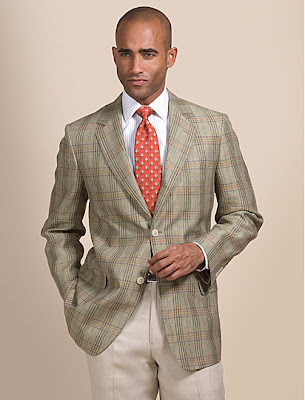
The ubiquitous Navy Blazer and a plaid sportcoat best worn with khakis or dark slacks

As far as how to wear a sport coat, that is entirely dependent upon both the wearer, and the occasion. Like a suit jacket, the bottom button, whether with a two or three button jacket, should always be opened, and while I very rarely open all the buttons on my suit, this is far more appropriate while wearing the more casual sport coat.

I personally think that sport coats are best when paired with slacks or khakis and decent shoes. Blue is a good go-to color, but there are many options to go through – just remember to keep your basic style rules in place. No mixing browns and blacks, shoes must match with belt and socks (you'd be surprised how often this is overlooked) etc. Depending on the weather, they can be worn with a vest or a sweater underneath, and typically a dress shirt. A tie is purely dependent on personal preference and the formality of the occasion.

An example of how a sport coat can be a very elegant business look. Take away the tie, add jeans and boat shoes, and you have a classy but still casual feel.

A sport coat with jeans can be great for casual Fridays, or any casual occasion where one just cannot bring themselves to wear a t-shirt or a hoodie – and again, these are more common than one might initially think. Street shoes or deck / boat shoes are an excellent choice with this look – especially if matched with the coat. If worn with a t-shirt of sweatshirt, make sure it is a solid color, or something unobtrusive. Your swagger should make the statement, not the logo.

On more formal occasions, even those without a tie, a pocket square can be an interesting addition. While in a suit I typically like clean, smooth lines, and keep mine squared off over the pocket, but in a sport coat, you can get away with far more interesting colors and styles. Try a peaked fold, or have the edges splayed out of the pocket. This works especially well with a bordered pocket square.

If you are still building your wardrobe, start off with something blue – it can go with everything, and can easily be built upon, but don't shirk the idea of a gray or tan coat. The more you use them the more you will find ways they are useful. Don't get caught up with one look or style. Experiment and play around with it, and it helps to keep your options open. Like I have always been told, “if all you have is a hammer, everything looks like a nail.” This old adage can be applied to everything from tools to tactics to fashion. Use what you have, but don't become too attached to your methods.

Sportcoat and hoodie? Don't be that guy. Seriously, you're better than that.